
Innovobot Labs

Human-Machine Interface Lab

We make technology you can feel.

Touch, voice, gesture, vision and haptics are where a product earns trust or loses it. We engineer interfaces that help people operate complex machines safely and intuitively, while reducing interface risk before it becomes late-stage redesign.

Haptics deployed at global scale. Our team engineered haptics deployed in billions of devices, including the PlayStation®5 DualSense™ controller.
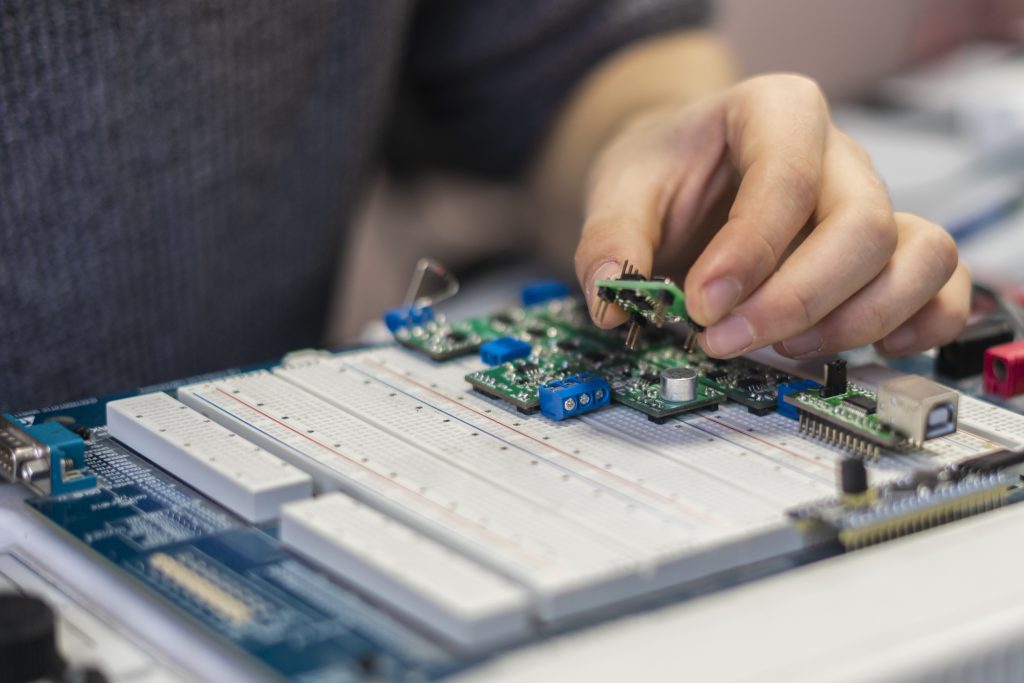
Human Machine Interface (HMI) Lab

Innovobot’s HMI Lab designs next-generation interaction systems that enable intuitive, safe, and efficient collaboration between humans and intelligent machines.

Our team includes pioneers of modern haptics and human-machine interaction, behind technologies deployed in billions of consumer and industrial devices, including the PlayStation®5 DualSense™ controller, and foundational innovations that transformed mobile haptics at Samsung. 

Our multidisciplinary teams develop multimodal interfaces. By tightly integrating HMI, AI, and IoT, we help organizations deliver business-ready systems that redefine user experience and operational excellence.

Capabilities

The HMI problems changing now

Four problems on every HMI roadmap right now.

The interface is becoming one of the hardest parts of the product. Regulation, operator workload and AI are changing what a successful HMI has to do.

Automotive · Mobility


Regulators are taking the touchscreen back.
Euro NCAP's 2026 protocol places greater emphasis on how drivers access essential vehicle functions, including control placement, target size and tactile identification. Where distraction creates risk, interface design has to account for more than what fits on a screen.

Source: Euro NCAP 2026 protocol (SD 203), in force January 2026.

How we help

Control strategies designed around reduced visual demand without surrendering industrial design: tactile-differentiated surfaces, localized haptics on glass and physical-feeling controls in thin packages.

Consumer electronics · XR · Industrial


Multimodal is harder than any single mode.
Voice, touch, gesture and haptics each work alone. Together they create arbitration problems: which input wins, what the user knows is listening and what happens when a channel fails. Real-world conditions expose the seams.

How we help

We rebuild the hierarchy around what the operator has to decide, not simply what the system can report. Tactile feedback adds a distinct channel when visual and auditory channels are already busy.

MedTech · Wearables


Use error is a gating item in regulated markets.
IEC 62366-1 and FDA human factors guidance make usability engineering and use-related risk part of the medical-device development process. Addressing human factors early reduces the risk of discovering critical usability issues late in development.

Source: IEC 62366-1:2015+AMD1:2020; FDA human factors guidance.

How we help

Human factors from first concept: use-related risk analysis, critical task definition, formative cycles and interface design prepared for validation.

Robotics · Automotive · Industrial


AI changed what the interface has to do.
When a system acts on its own, the interface has to make intent legible, calibrate trust and keep a human able to intervene. Too little transparency and users reject automation. Too much and they are back to overload.

How we help

We rebuild the hierarchy around what the operator has to decide, not simply what the system can report. Tactile feedback adds a distinct channel when visual and auditory channels are already busy.

Connected capabilities

What we build

One HMI problem can span interaction design, sensing, electronics, firmware, intelligence and human factors. We bring those disciplines together around the system.

 
High-definition haptics Smart panels and surfaces Physical control design Multimodal alerting
Voice and speech Gesture and vision Touch, force and pressure sensing Wearables

AR/XR and spatial interaction

Digital twins and remote operation

Adaptive and ML-enhanced interfaces

Safety-aware interfaces

Usability engineering

Use-related risk analysis

Accessibility

Field validation

Where we go deepest

Four things touch does that a screen can’t.

Haptics is one of our deepest areas of expertise, and a channel many product teams still underuse.

Haptics

Beyond the interface itself, haptics can support simpler control architectures, stronger operator awareness and new forms of remote interaction.

How we work

One path from interface risk to production-ready decisions.

We enter at whichever stage you need, then connect the user, technical and commercialization decisions that need to move together.


Frame the real problem

Map the technology, user and regulatory landscape before major design decisions are locked in.


Design the interaction

Concept development, interaction architecture and user experience.


Prototype with real users

Experiential prototypes in real conditions, where technical risk can be reduced and new IP can emerge.

Get it to production

Pre-production design, human factors documentation, IP strategy and manufacturing readiness.

Engagement scope

From interface risk to production-ready decisions.

We enter at whichever stage you need, then connect the user, technical and commercialization decisions that need to move together.

Technology

Problem framing
Interaction design and UX
Human factors and usability engineering
Experiential prototyping
Pre-production design
Software and firmware development
Systems integration

Commercialization support

Manufacturing readiness
Supplier and partner coordination
Transition planning from prototype to pre-production
IP strategy
Regulatory and validation support
Cross-Lab technical coordination

Selected experience

Proof, not promises.

Examples of interface work across medical devices, automotive and consumer electronics.

MedTech · Cardiac

Restoring touch in cardiac surgery

Partner: HapticHeart Solutions

The challenge

Robotic and minimally invasive cardiac procedures eliminate the tactile feedback surgeons rely on. HapticHeart Solutions needed to restore that sense of touch: in real time, with low latency, integrated into surgical workflows.

Our approach

We developed modular wearable haptics integrated into surgical gloves and armbands, delivering low-latency force and pressure feedback to improve procedural precision. Validated with clinicians and showcased at the Heart Rhythm Society meeting.

Outcome

A clinically validated wearable haptic system advancing toward commercialization: proving HMI’s critical role in life-saving applications.

Consumer electronics

Automated haptic effects testing

Partner: Dell

The challenge

Lack of a reliable system to characterize haptic feedback, causing inconsistencies between measured parameters and user experience.

Our approach

Innovobot co-developed a robotic testing platform with Dell, paired with in-house analytics to automatically characterize haptic feedback: delivering a repeatable, data-driven system that improved accuracy, speed, and UX insight.

Outcome

Co-developed with Dell, resulting in joint IP filing and shared commercialization revenue.

Automotive · Consumer electronics
Automotive haptic display

Partner: TDK, BOE, Microchip

The challenge

Develop a high-definition haptic automotive display that integrates advanced components while reducing cost and meeting automotive durability standards.

Our approach

Using a whole-system, co-development approach with three partners, Innovobot delivered a reference tactile display design: integrating sensors, actuators, suspension and structure, optimized for user-friendly, automotive-rated haptic performance.

Outcome

Achieved over 60% cost reduction and improved tactile performance and reliability, delivering a scalable, market-ready innovation built on Innovobot’s expertise in systems integration, haptics and UX design.

Consumer electronics
Intelligent haptic seating for in-flight, automotive, and beyond

Partner: Inflight Canada

The challenge

Passenger and occupant comfort: in flight, in vehicles, and beyond, was limited to visual and audio experience, with no scalable way to add meaningful physical comfort and wellness through the seat itself.

Our approach

We designed and prototyped a full haptic seating system with multipoint spatial feedback: an immersive concept, synchronized with entertainment, built to support relaxation and wellness across seating applications from aviation to automotive.

Outcome

Improved sleep quality, reduced fatigue, and a differentiated experience, with Inflight Canada as the first proof point for a seating platform designed to extend beyond it.

Ecosystem leverage

You get our partners too.

Interface problems rarely sit inside one company. We bring together the relevant engineering disciplines, suppliers and partners so integration and production constraints can be considered earlier in the program.

The Haptics Company

Founded with Innovobot Labs, XeelTech and STIWA to make haptic systems practical at production scale.

Interhaptics — a Razer company

Integration partner for Razer Sensa HD haptics.

GREWUS

Accelerating haptic actuator development and time to market.

Voler Systems

An Innovobot company. 46 years and 900+ projects in sensors, wireless and mixed-signal design.

Haptics Industry Forum

Our Chief Scientist chairs the board.

Who we work with

Built for teams making consequential interface decisions.

Startups & scaleups

You have a breakthrough and a deadline. We de-risk the hardest interface bet and get you to a prototype customers can hold.

Enterprise product teams

You need differentiated interaction, stronger usability and a credible path through regulatory or production constraints.

Component & tier-1 suppliers

Your technology is excellent and hard to adopt. We build the reference designs that lower the barrier.

FAQ

Questions we hear early.

With a short, paid discovery phase: we frame the problem, survey the technology and regulatory landscape, and return with paths, costs and risks. You own the output either way.

No. Haptics is where we’re deepest, but many interface programs are multimodal. The right answer may combine touch, voice, gesture, vision, physical controls and haptics depending on the use case.

Yes. We support usability engineering aligned to IEC 62366-1 and FDA human factors expectations, including formative and summative evaluation.

Both, through pre-production design and manufacturing readiness.

Start a conversation

Tell us the problem and the constraint: cost, thickness, power, timeline or regulatory path: and we’ll tell you straight whether it is solvable and what it takes.

↑ GET STARTED